
WHY I ADVISE AGAINST HIP HOP BEFORE THE AGE OF 10

This is probably the question I get asked most often in September at the shop counter: "My daughter is 6 years old, she wants to do hip-hop like on TikTok. What do you think?"
And each time, I answer the same thing, very cautiously: I would wait.
This isn't a judgment on hip-hop. It's a demanding, technical discipline with an incredibly rich culture and history. I have immense respect for urban dancers and the teachers who dedicate themselves to it. But after years of performing and thousands of conversations with parents, teachers, and physical therapists, I've come to a firm conviction: between the ages of 4 and 9, there are better things for a child who wants to dance to do.

Here's why:
1. A 6-year-old child's body is not a small adult body.

This is the most important point, and the least visible.
Before the age of 10, a child's skeleton is still largely cartilaginous. Growth plates are active, wrist bones are not fully ossified, and the cervical spine supports a head that is proportionally much heavier than in adults. The structures are flexible—and therefore resistant to certain stresses—but vulnerable to repeated compression and torsional loads.
What do we do a lot of in hip-hop, and particularly in breakdancing? We do footwork on our wrists and elbows. We do freezes balanced on one shoulder. We do rotations, controlled falls, and hard landings.
For a prepared adolescent or adult, it's work. For a 7-year-old child whose shoulder girdle has no baseline tone, it's a load placed on joints that are not yet able to withstand it.
Let me be clear: I'm not saying a child will get injured in the first lesson. I'm saying that repeating the exercise over several seasons, on immature structures, is a gamble I wouldn't take with my own child.
2. Isolation exercises require a body schema that is not yet present.
Hip-hop is based on dissociation: moving the torso without the hips, the head without the shoulders, one arm without the other. This is what makes it unique and difficult.

This ability relies on proprioception—the fine awareness of the position of each segment of the body—which gradually develops and stabilizes around the age of 8-10. Before that, the child imitates. They reproduce an overall shape, often with compensation: they twist their lower back to give the illusion of a pelvic movement, they tense their shoulders to emphasize a point.
The result: he learns the movement without the mechanics. And breaking a bad motor habit at 12 years old takes infinitely longer than building it up properly at 10 years old.
3. Many "kids' hip-hop" classes are not actually hip-hop classes.
This is the sticking point, but it needs to be said.
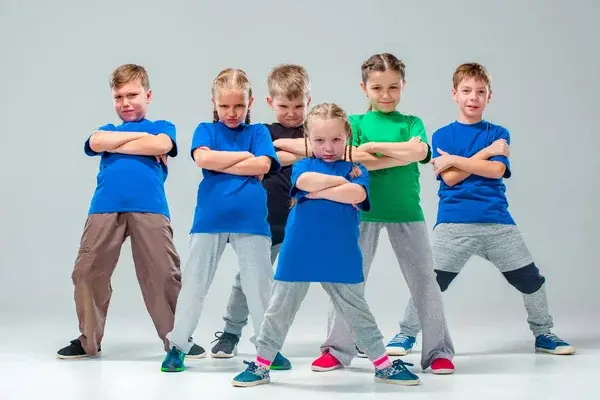
A true urban dance class involves a structured warm-up, foundational work (groove, bounce, rock), a movement culture, and progression. It exists, and the teachers who offer it are excellent.
But in many schools—not all, far from it—the "hip-hop 5-8 year olds" class is actually a choreography class set to current hit music. A routine is created for the recital, rehearsed, and performed again. The child spends an entire season memorizing twenty seconds of movements without ever building a technical foundation, without a warm-up adapted to their physiology, and sometimes without even understanding the origins of the dance.
It's pleasant. It's not training.
4. The question of the directory and codes
We also need to dare to talk about the content.

Current music, the music videos children watch, viral dance routines: the lyrics and movements aren't always designed for 7-year-old bodies. I see videos of galas where little girls reproduce movements whose meaning they don't understand at all—and I see parents uncomfortable in the audience, unaware of their feelings.
A good teacher filters, adapts, and chooses their repertoire. Not all teachers do this. And at 6 years old, a child has no critical perspective on what they are asked to embody.
What I'm not saying
To be very clear, because I know this article will provoke a reaction:
Hip-hop is not a dangerous discipline in itself.
A child who did hip-hop at age 6 is not "damaged".
An excellent urban dance teacher trained in child pedagogy will do infinitely better than a poorly supervised classical dance class.
My reservation concerns not so much the discipline itself, but rather the clash between an immature body and often unsuitable course content. If you find a teacher who provides a thorough warm-up, prohibits floor exercises before a certain age, works on groove before choreography, and carefully selects their repertoire, then go for it without hesitation.
What I recommend for ages 4 to 9
The idea is not to say no to a child who wants to dance. It's to give them the foundations that will make their hip-hop much better at age 10.
4-6 years : awakening and initiation to dance. Laterality, rhythm, spatial awareness, the joy of movement. This is the foundation of everything, regardless of the discipline pursued later.
Ages 6-9 : Classical, jazz, or contemporary. Classical dance focuses on alignment, pelvic positioning, and core muscle tone. Jazz introduces rhythm and energy, with movements closer to what children are looking for. Contemporary dance develops a connection to the floor and body weight—a valuable foundation for floorwork later on.
In addition : gymnastics or acrogym. To build the shoulder girdle and core strength, precisely what is lacking when approaching breakdancing.
And at 9-10 years old , when the child arrives in hip-hop with proper positioning, rhythm and a ready body: they progress three times faster. I've seen it dozens of times.
And what about equipment?
Regardless of the chosen discipline, two simple rules apply:
Proper shoes are essential , never just everyday sneakers. A dance sneaker has a pivoting sole that allows for rotations without locking the knee, and cushioning designed for landings. A classic athletic shoe grips the floor—it's the knee that absorbs the torsion.
An outfit that reveals the body . The teacher needs to be able to correct posture. A sweatshirt three sizes too big makes their job impossible.
In the shop, I always take the time to ask about age, discipline, and class frequency before recommending a pair of shoes or an outfit. It's not the same thing to outfit a 5-year-old in introductory class as it is to outfit a 13-year-old who does 10 hours of dance a week.
Unsure what you need for back to school? Come see me at the shop, or write to me: I'll reply personally.
Virginie


Comments